
- English
- 简体中文
- Español
- Português
- русский
- Français
- 日本語
- Deutsch
- tiếng Việt
- Italiano
- Nederlands
- ภาษาไทย
- Polski
- 한국어
- Svenska
- magyar
- Malay
- বাংলা ভাষার
- Dansk
- Suomi
- हिन्दी
- Pilipino
- Türkçe
- Gaeilge
- العربية
- Indonesia
- Norsk
- تمل
- český
- ελληνικά
- український
- Javanese
- فارسی
- தமிழ்
- తెలుగు
- नेपाली
- Burmese
- български
- ລາວ
- Latine
- Қазақша
- Euskal
- Azərbaycan
- Slovenský jazyk
- Македонски
- Lietuvos
- Eesti Keel
- Română
- Slovenski
- मराठी
- Srpski језик

How Does a Pockels Cell Driver Optimize Laser System Performance?
Article Summary
A Pockels cell driver is a critical component in modern laser systems, enabling precise control of laser pulse timing, amplitude, and polarization. Understanding how Pockels cell drivers function, how to select the appropriate type, and how to optimize system integration can solve many common issues in research, industrial, and medical laser applications.
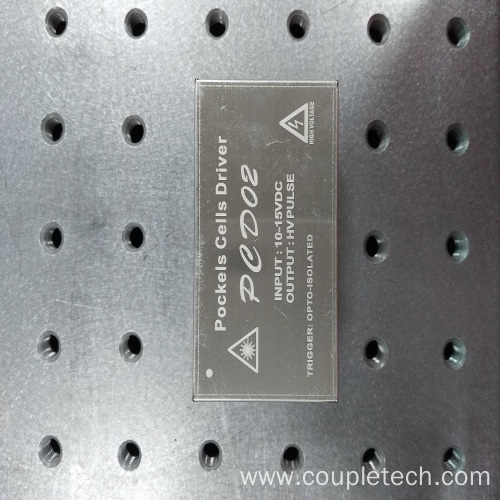
Table of Contents
- Pockels Cell Driver Overview
- Common Customer Pain Points
- Types of Pockels Cell Drivers
- How to Select the Right Driver
- Integration and Performance Factors
- Driver Performance Comparison
- Quality Assurance and Reliability
- Application Scenarios
- Frequently Asked Questions
- Conclusion and Contact Us
Pockels Cell Driver Overview
A Pockels cell driver is an electronic device that applies high-voltage pulses to a Pockels cell, enabling rapid modulation of light in terms of polarization and amplitude. These drivers are essential for Q-switching, pulse picking, and high-speed optical modulation in laser systems. The performance of a Pockels cell driver directly impacts pulse precision, energy stability, and overall laser output quality.
Coupletech Co., Ltd. specializes in delivering reliable and high-speed Pockels cell drivers, designed for compatibility with a wide range of laser configurations and ensuring optimal pulse control for research, medical, and industrial applications.
Common Customer Pain Points
Customers working with laser systems often face challenges related to Pockels cell driver performance. Common issues include:
- Poor pulse rise and fall times, reducing modulation accuracy
- Inconsistent voltage output affecting laser pulse quality
- Thermal management problems in high-repetition-rate systems
- Electromagnetic interference (EMI) impacting nearby electronics
- Limited driver lifetime under demanding operating conditions
Addressing these challenges requires careful selection of driver specifications, system integration, and monitoring performance parameters.
Types of Pockels Cell Drivers
Pockels cell drivers are available in several designs, each suited to specific laser system requirements:
- High-Voltage Pulse Drivers – Provide rapid high-voltage pulses for Q-switching applications.
- Low-Voltage Analog Drivers – Offer continuous modulation with precise amplitude control.
- TTL-Triggered Drivers – Enable digital synchronization with external laser timing systems.
- Repetition-Rate Optimized Drivers – Designed for high-speed pulse repetition without performance degradation.
Coupletech Co., Ltd. offers a full spectrum of Pockels cell drivers to accommodate different pulse speeds, voltages, and control modes.
How to Select the Right Driver
Choosing the correct Pockels cell driver involves evaluating several technical factors:
- Required voltage range and pulse amplitude
- Pulse rise/fall times and switching speed
- Repetition rate and thermal performance
- Compatibility with the specific Pockels cell and laser type
- Control interface (analog, TTL, or digital)
- EMI shielding and system reliability requirements
Coupletech Co., Ltd. provides technical support to guide customers in selecting a driver that matches system specifications while maximizing laser performance.
Integration and Performance Factors
The performance of a Pockels cell driver depends not only on the driver itself but also on how it is integrated into the laser system:
- Proper cable routing and shielding to minimize noise
- Synchronization with laser control electronics
- Temperature control and cooling to prevent voltage drift
- Routine calibration and testing for pulse accuracy
- Maintaining clean and stable power supplies
Following these integration best practices ensures high reproducibility, reduced downtime, and consistent laser output.
Driver Performance Comparison
| Driver Type | Voltage Range | Rise/Fall Time | Best Applications |
|---|---|---|---|
| High-Voltage Pulse | 0–5 kV | 5–20 ns | Q-switching, pulse picking |
| Low-Voltage Analog | 0–500 V | Variable | Amplitude modulation, continuous wave lasers |
| TTL-Triggered | 0–4 kV | 10–50 ns | Digital synchronized pulsed lasers |
| Repetition-Rate Optimized | 0–3 kV | 5–15 ns | High-frequency laser systems |
Quality Assurance and Reliability
Reliable performance in Pockels cell drivers requires rigorous quality assurance. Key quality control measures include:
- Voltage stability testing across temperature ranges
- Electromagnetic interference (EMI) evaluation
- Switching speed verification for nanosecond-level precision
- Thermal performance assessment for high-repetition-rate operation
- Lifetime testing under continuous operation
Coupletech Co., Ltd. maintains strict manufacturing and testing protocols to ensure each driver delivers dependable, long-term operation in demanding laser systems.
Application Scenarios
Pockels cell drivers are used in a wide range of laser applications:
- Industrial laser machining and cutting
- Scientific research and ultrafast laser experiments
- Medical laser systems and ophthalmic surgery
- Defense and aerospace laser technologies
- High-speed optical communication experiments
Frequently Asked Questions
What is the main function of a Pockels cell driver?
It provides controlled high-voltage pulses to a Pockels cell, enabling fast modulation of laser light in amplitude and polarization.
Can one driver work for multiple Pockels cell models?
Only if the voltage range, pulse speed, and control interface match the Pockels cell specifications.
How is pulse precision ensured?
Through fast rise/fall times, stable voltage output, and careful synchronization with laser system electronics.
Do drivers require regular maintenance?
Yes, periodic calibration, temperature monitoring, and electrical checks ensure optimal performance and longevity.
Conclusion and Contact Us
A Pockels cell driver is a vital element in precise laser control, influencing pulse quality, system reliability, and application performance. Understanding driver types, selection criteria, integration factors, and quality assurance practices helps laser system operators achieve consistent results while minimizing downtime.
Coupletech Co., Ltd. offers high-performance Pockels cell drivers designed for research, industrial, and medical laser applications. For expert guidance, product inquiries, or to find the optimal driver for your laser system, contact us today and let Coupletech support your laser projects with reliable and precision-driven solutions.